Colonial rule in Malaya and Vietnam
Samuel's 14 pages of handwritten class notes, rebuilt as one page you can read on a phone. Malaya first (Britain), then Vietnam (France), then a side-by-side comparison and practice questions. The original photos are at the bottom if you want to check anything against the handwriting.
What this set of notes covers
Two case studies of the same story: a European power arrives for trade, finds a reason to step in, and ends up running the country.
- Malaya before 1874: only three British ports (Penang, Melaka, Singapore); the Malay states run themselves.
- Why Britain stepped in: four factors, and the Larut Wars in Perak that gave Britain its opening.
- The Pangkor Treaty (1874) and the Residential system: a British officer whose advice the Sultan must follow.
- Birch vs Low: how one Resident got killed and the next made the system work.
- Federated Malay States (1896) and the Unfederated Malay States (1909 onwards).
- Tin and rubber: who got rich, and the land policies that kept Malays out.
- Vietnam: the Nguyen dynasty, then the treaties of 1862, 1874, 1883 and 1884 that handed the country to France.
- Why France did it (God, Glory, Gold) and what French rule did to Vietnam's economy and society.
The one idea that ties it all together: neither power planned to conquer from day one. Each moved in step by step, usually when local trouble (civil war, a succession fight, attacks on missionaries) gave them an excuse, and when home politics or rivals made expansion attractive.
1 · Malaya before 1874: ports and states
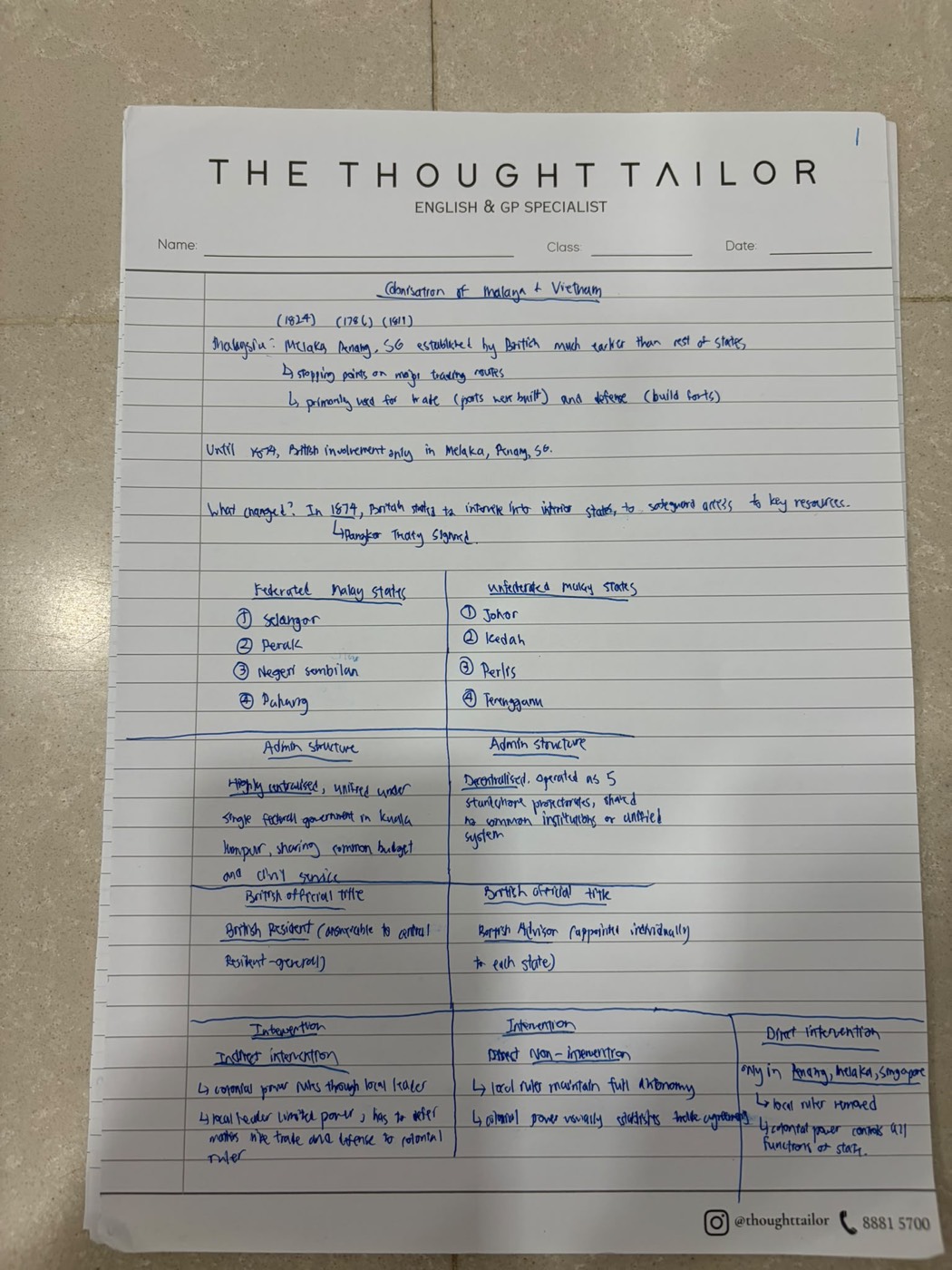
Britain got its three ports long before it touched the rest of the peninsula: Penang (1786), Singapore (1819) and Melaka (1824). Together they were the Straits Settlements. They were stopping points on major trade routes, used for trade (ports) and defence (forts).
Three kinds of British control (by 1914)
| Straits Settlements | Federated Malay States (FMS) | Unfederated Malay States (UMS) | |
|---|---|---|---|
| Who | Penang, Melaka, Singapore | Selangor, Perak, Negeri Sembilan, Pahang | Johor, Kedah, Perlis, Terengganu, Kelantan |
| Type of rule | Direct: local ruler removed, Britain runs every function of the state | Indirect: Britain rules through the Sultan, who must defer to British advice on everything except Malay religion and custom | Looser indirect: rulers keep much more autonomy; Britain mainly controls trade and foreign affairs |
| Admin structure | Colony under a British Governor | Highly centralised: one federal government in Kuala Lumpur, shared budget and civil service | Decentralised: five separate protectorates, no shared institutions |
| British official | Governor | Resident in each state, answerable to a central Resident-General | Adviser, appointed individually to each state |
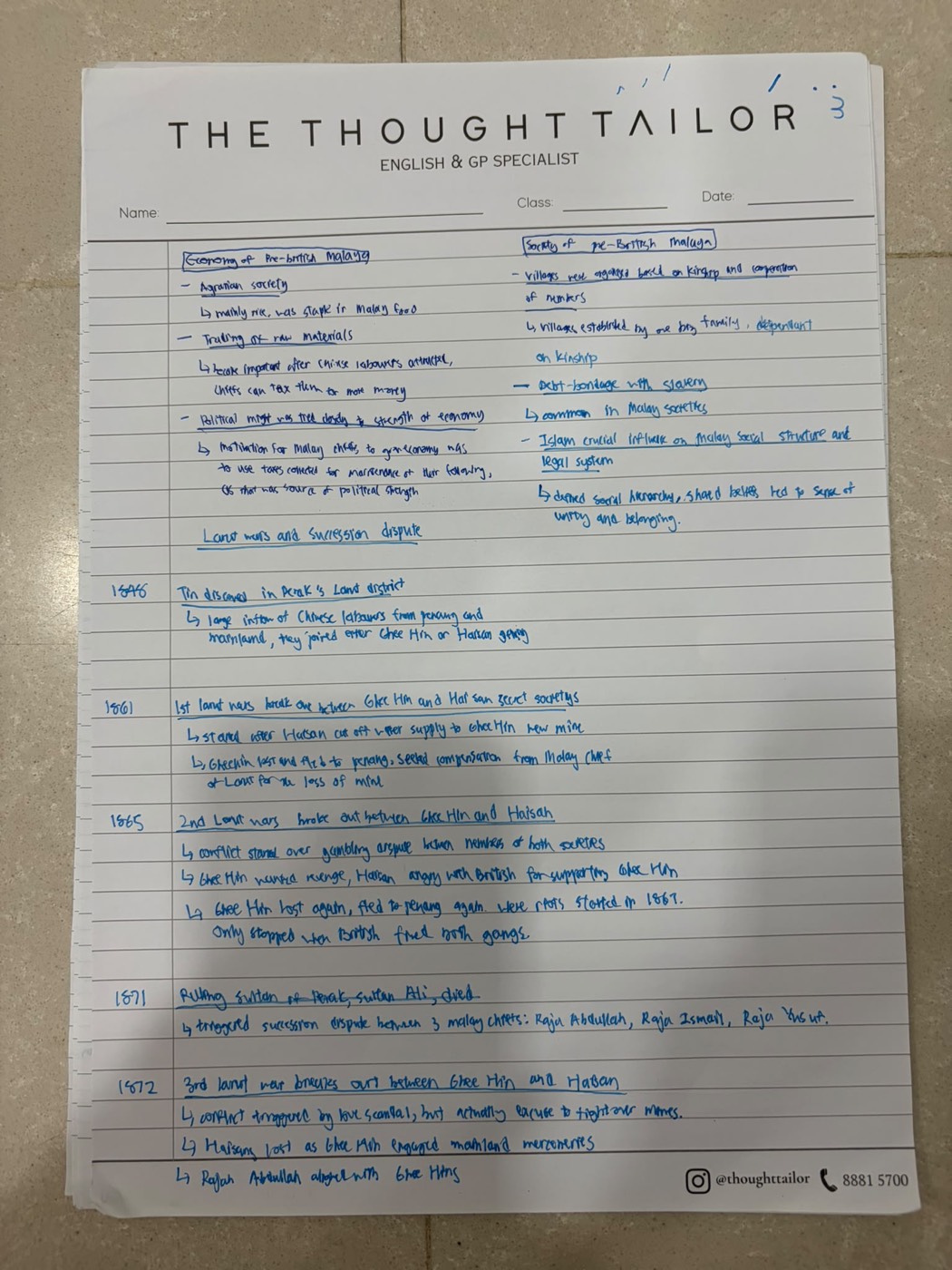
What the Malay states were like before the British
Economy
- Agrarian: mainly rice, the staple of Malay food.
- Trade in raw materials became important once Chinese labourers arrived; chiefs could tax them for more money.
- Political power was tied to the economy: chiefs used taxes to support their followers, and followers were the source of their strength.
Society
- Villages organised around kinship and cooperation, often founded by one large family.
- Debt bondage (a form of slavery) was common.
- Islam shaped the social structure and legal system, giving a clear hierarchy and a shared sense of belonging.
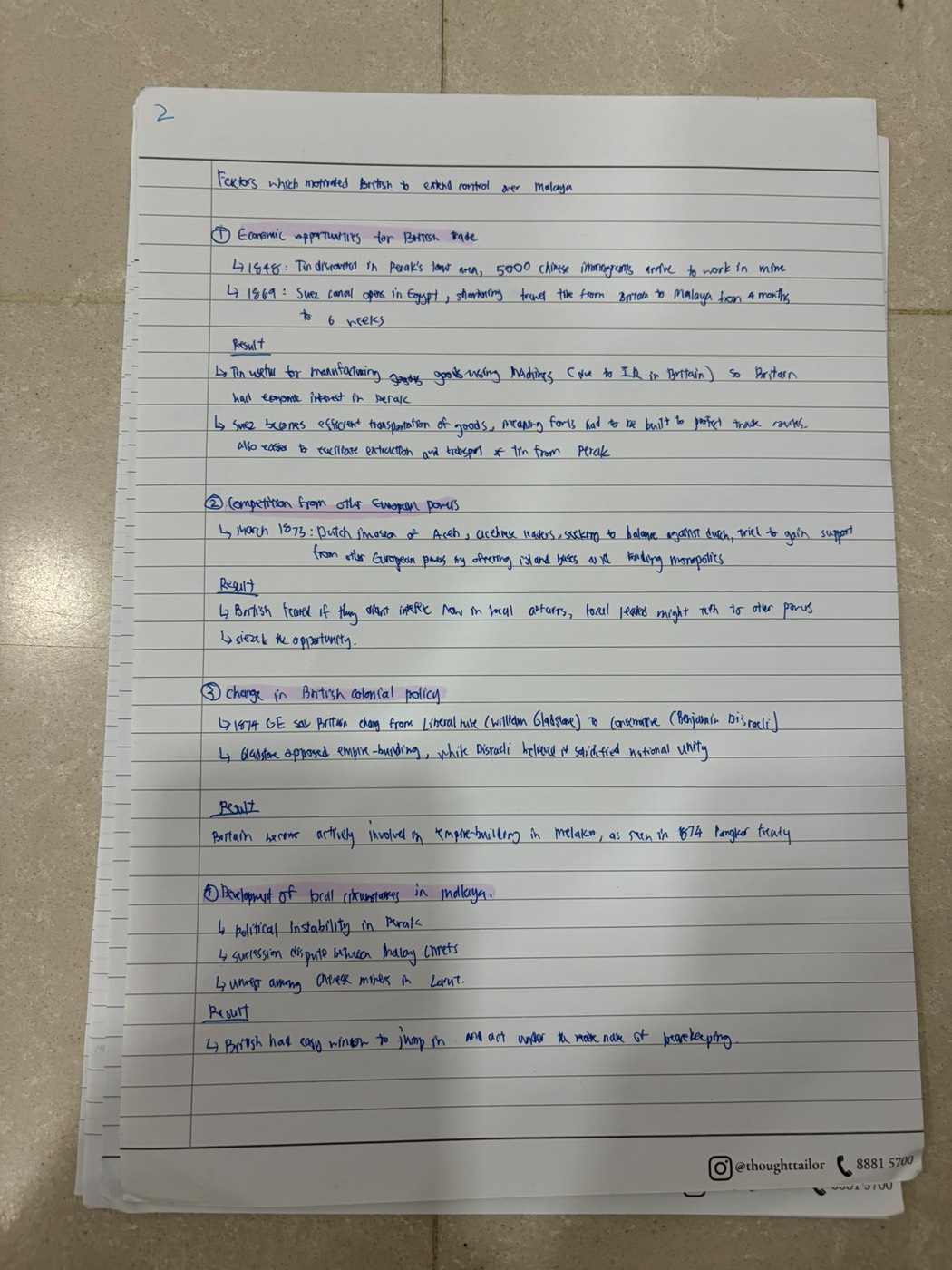
2 · Four reasons Britain moved into the Malay states
| Factor | What happened | Result |
|---|---|---|
| 1 · Economic opportunity | 1848: tin found in Larut, Perak; thousands of Chinese miners arrive. 1869: the Suez Canal opens, cutting the trip from Britain to Malaya from about 4 months to about 6 weeks. |
Britain's factories (Industrial Revolution) needed tin, so Britain now had an economic stake in Perak. Faster shipping made it easier to extract and export tin, and trade routes needed protecting. |
| 2 · Rival European powers | March 1873: the Dutch invade Aceh. Acehnese leaders try to win support from other European powers by offering island bases and trade monopolies. | Britain feared that if it did not step in, Malay rulers might turn to its rivals. So it seized the opportunity. |
| 3 · Change in British policy | 1874 general election: the Liberals under William Gladstone (against empire-building) lose to the Conservatives under Benjamin Disraeli (believed empire built national unity). | Britain became actively involved in empire-building in Malaya, as seen in the 1874 Pangkor Treaty. |
| 4 · Local conditions in Malaya | Political instability in Perak: a succession dispute between Malay chiefs plus fighting among Chinese miners in Larut. | Britain had an easy window to step in under the name of "peacekeeping". |
3 · The Larut Wars and the Perak succession dispute
Two Chinese secret societies, the Ghee Hin and the Hai San, fought four wars over the Larut tin mines. At the same time three Malay princes fought over who should be Sultan of Perak. In 1873 the two fights merged into one civil war.
- 1848Tin found in Larut. Chinese labourers pour in from Penang and the mainland and join either the Ghee Hin or the Hai San.
- 18611st Larut War. Starts when the Hai San cut off water to a Ghee Hin mine. The Ghee Hin lose, flee to Penang and demand compensation from the Malay chief of Larut.
- 18652nd Larut War. Starts over a gambling dispute. The Ghee Hin want revenge; the Hai San are angry that the British backed the Ghee Hin. The Ghee Hin lose again; riots follow in 1867 and stop only when the British fine both sides.
- 1871Sultan Ali of Perak dies. Succession fight between three chiefs: Raja Abdullah, Raja Ismail and Raja Yusuf.
- 18723rd Larut War. Triggered by a love scandal, really a fight over mines. The Ghee Hin hire mercenaries from the mainland and win. Raja Abdullah sides with the Ghee Hin.
- 18734th Larut War. The Hai San retake Larut; the Ghee Hin, backed by Abdullah, counter-attack. The succession dispute becomes a full civil war.
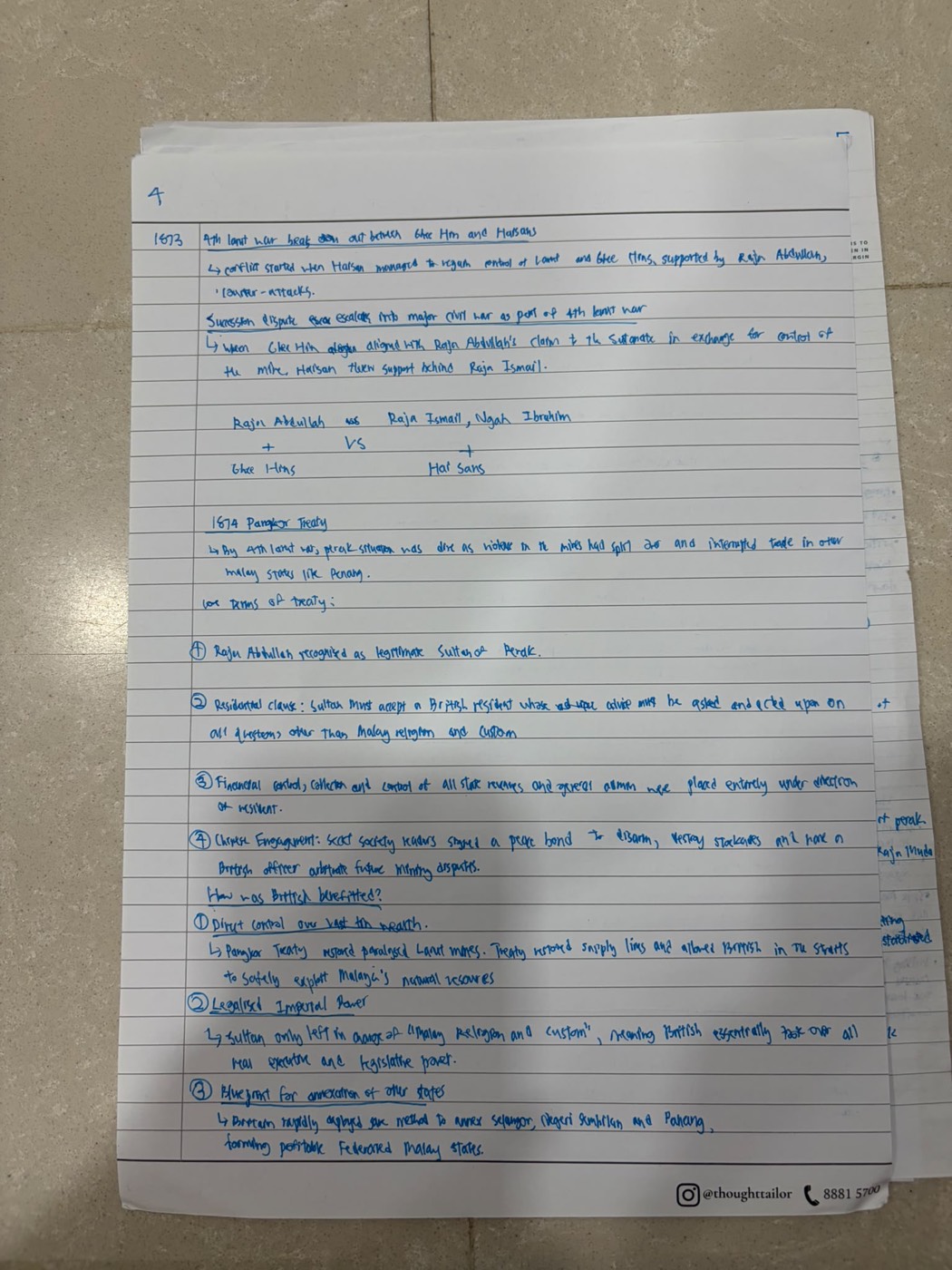
The Ghee Hin backed Abdullah's claim to the throne in exchange for control of the mines, so the Hai San threw their weight behind Ismail.
4 · The Pangkor Treaty (1874)
By the 4th Larut War the violence in the mines had spilled over and was disrupting trade in the Straits Settlements such as Penang. Britain brokered a settlement.
Four terms
- Raja Abdullah recognised as the legitimate Sultan of Perak.
- Residential clause: the Sultan must accept a British Resident, whose advice must be asked and acted upon on all questions other than Malay religion and custom.
- Financial control: collection and control of all state revenue and general administration placed under the Resident.
- Chinese settlement: secret society leaders sign a peace bond to disarm, destroy their stockades and let a British officer settle future mining disputes.
How Britain benefited
5 · The Residential system: Birch vs Low
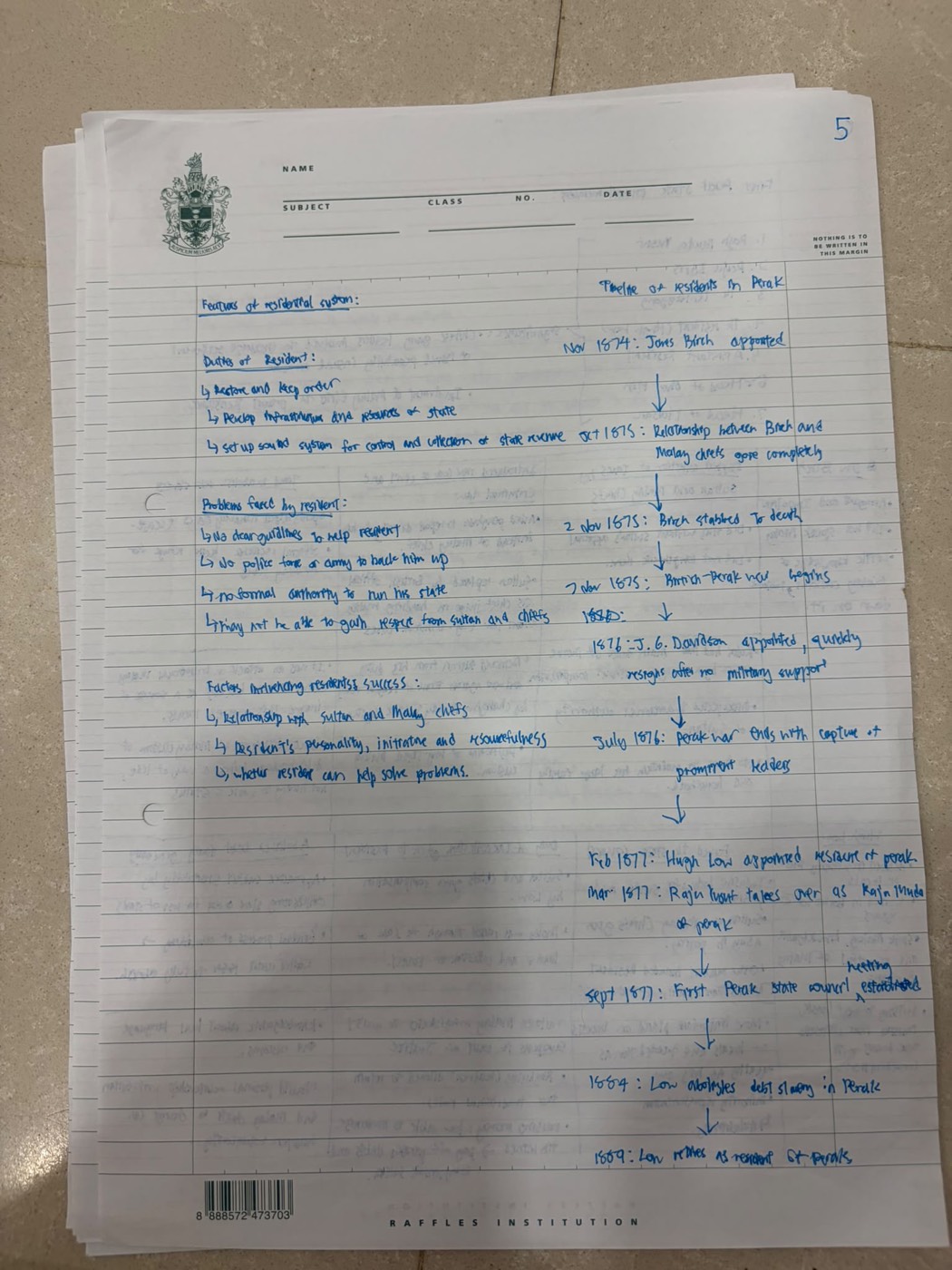
The Resident's job
- Restore and keep order
- Develop infrastructure and the state's resources
- Set up a proper system to collect and control state revenue
Problems he faced
- No clear guidelines
- No police or army to back him up
- No formal authority to run the state
- May not win the respect of the Sultan and chiefs
What decided success: his relationship with the Sultan and chiefs; his personality, initiative and resourcefulness; and whether he could actually solve local problems.
Timeline of Residents in Perak
- Nov 1874J.W.W. Birch appointed Resident.
- Oct 1875Relations between Birch and the Malay chiefs break down completely.
- 2 Nov 1875Birch is stabbed to death. The Perak War begins days later.
- 1876J.G. Davidson appointed, resigns quickly after getting no military support.
- Jul 1876Perak War ends with the capture of the leaders.
- 1877Hugh Low appointed Resident. Raja Yusuf becomes Raja Muda (heir) and acts as ruler. In September the first Perak State Council meets.
- 1884Low abolishes debt slavery in Perak.
- 1889Low retires.
Same job, opposite results
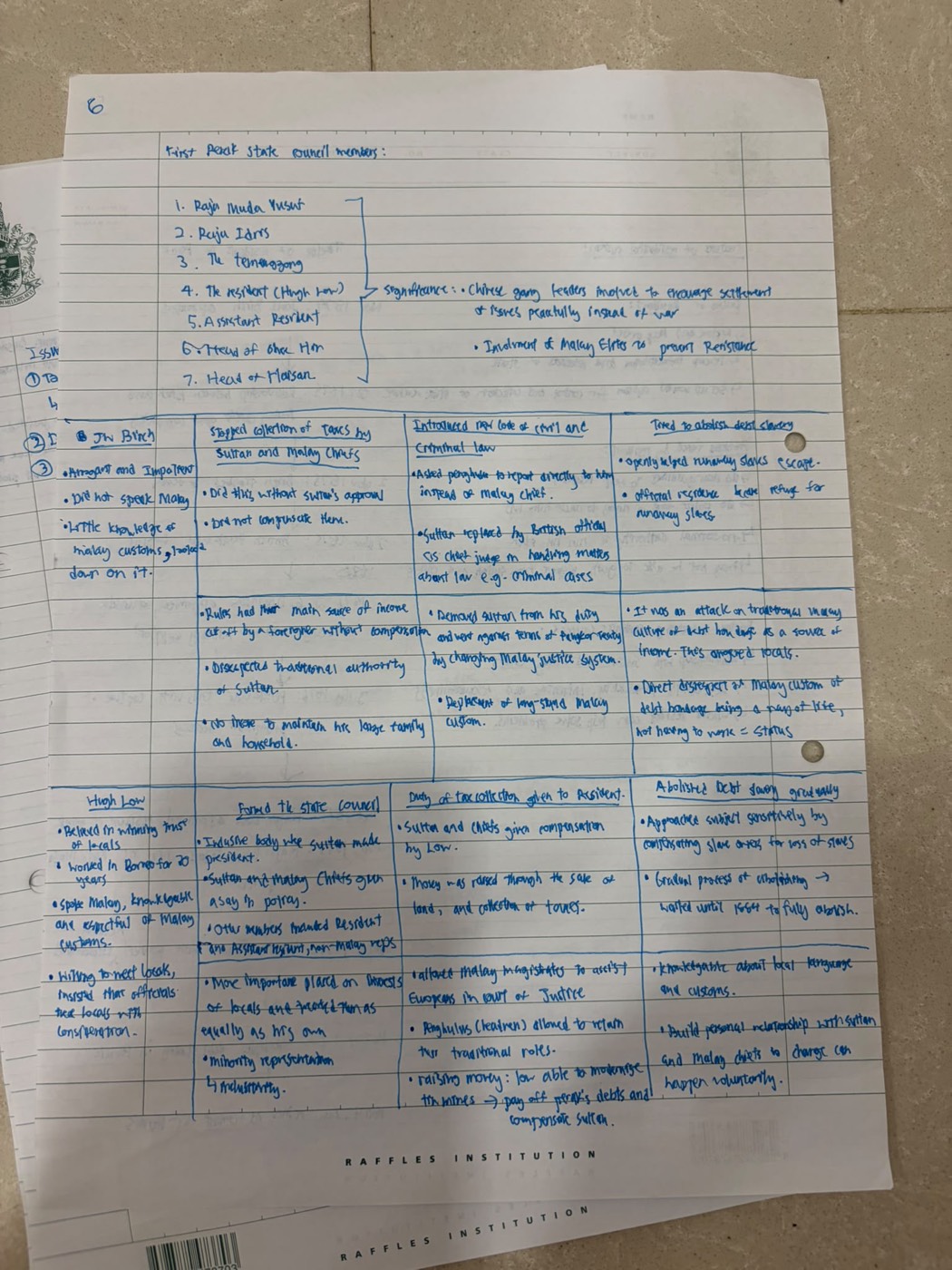
| Issue | J.W.W. Birch (failed) | Hugh Low (succeeded) |
|---|---|---|
| Personality | Arrogant and impatient. Did not speak Malay. Knew little of Malay customs and looked down on them. | Believed in winning the locals' trust. 30 years' experience in Borneo. Spoke Malay, respected Malay customs. Insisted officials treat locals with consideration. |
| Taxes | Stopped the Sultan and chiefs collecting taxes, without the Sultan's approval and without compensation. Rulers lost their main income to a foreigner, and could no longer support their large households. | Took over tax collection but compensated the Sultan and chiefs, paying for it through land sales and taxes. Used tin revenue to pay off Perak's debts. |
| Law and courts | Brought in a new civil and criminal code. Told village headmen (penghulu) to report to him, not to their chief. Replaced the Sultan as chief judge. Seen as breaking the Pangkor terms by changing the Malay justice system. | Let Malay magistrates sit with Europeans in court. Penghulu kept their traditional roles. |
| Debt slavery | Openly helped runaway slaves escape; his residence became a refuge. Seen as a direct attack on Malay custom and on a source of income and status. | Abolished it gradually, compensated slave owners, and waited until 1884 to finish. Used personal relationships so change felt voluntary. |
| Sharing power | Ruled over the chiefs' heads. | Formed the State Council: the Sultan as president, Malay chiefs given a say in policy, Chinese leaders represented too. |
The first Perak State Council (1877)
Members: Raja Muda Yusuf, Raja Idris, the Temenggong, the Resident (Hugh Low), the Assistant Resident, the head of the Ghee Hin, the head of the Hai San.
6 · From Residents to a federation, 1889 to 1909
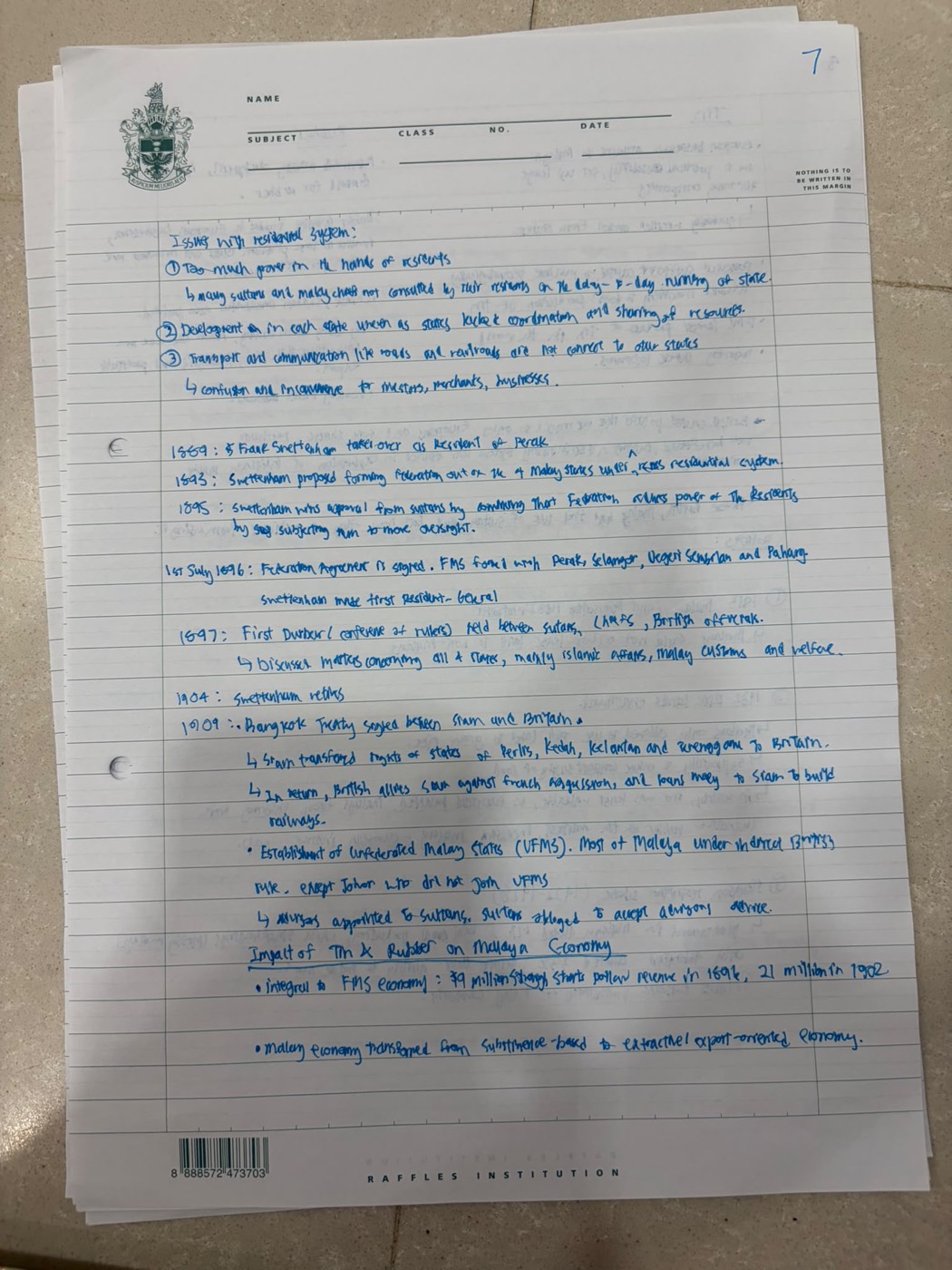
What was wrong with the Residential system
- Too much power in the Residents' hands: many Sultans and chiefs were not consulted on day-to-day running of the state.
- Uneven development: each state on its own, no coordination or shared resources.
- Roads and railways did not connect across states, confusing and inconvenient for miners, merchants and businesses.
- 1889Frank Swettenham becomes Resident of Perak.
- 1893Swettenham proposes a federation of the four states to fix the Residential system.
- 1895He wins the Sultans' approval by arguing a federation would reduce the Residents' power by putting them under more oversight.
- 1 Jul 1896Federated Malay States formed: Perak, Selangor, Negeri Sembilan, Pahang. Swettenham becomes the first Resident-General.
- 1897First Durbar (conference of rulers): Sultans, chiefs and British officers discuss matters for all four states, mainly Islamic affairs, Malay customs and welfare.
- 1904Swettenham retires.
- 1909Bangkok Treaty: Siam transfers Perlis, Kedah, Kelantan and Terengganu to Britain. In return Britain backs Siam against French aggression and lends Siam money for railways. These become the Unfederated Malay States, each with a British Adviser whose advice the Sultan must accept.
7 · Tin, rubber, and who really benefited
Tin and rubber turned Malaya from a subsistence economy into an export economy built on extracting raw materials. Tin was central to the FMS budget: Samuel's notes record revenue of about $9 million in 1896 rising to $21 million by 1902.
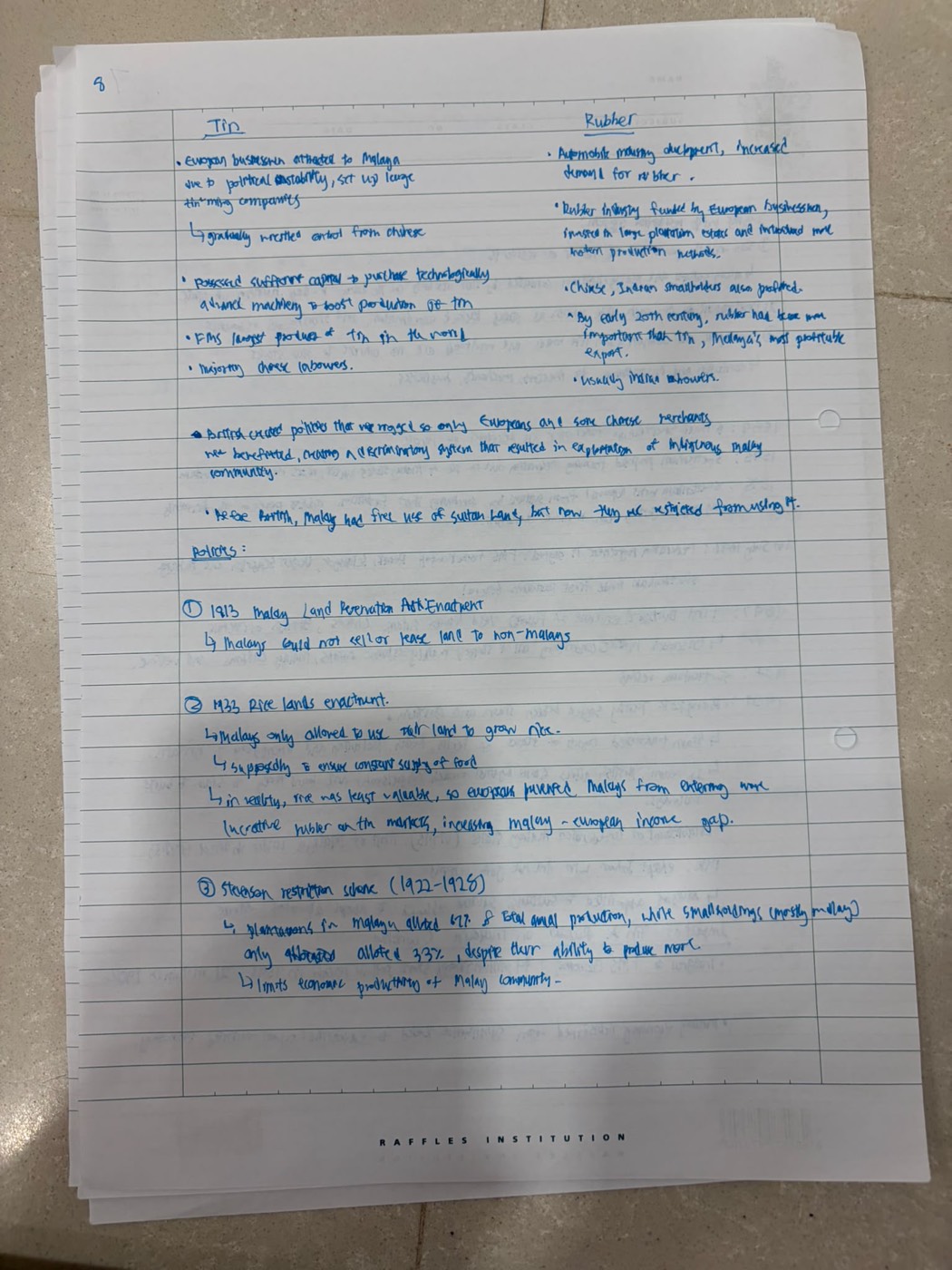
Tin
- Political stability drew European businessmen, who set up large mining companies.
- They had the capital for modern machinery, and gradually took control from the Chinese.
- The FMS became the world's largest tin producer.
- Workers: mostly Chinese.
Rubber
- The car industry created huge demand.
- European capital built large plantation estates; Chinese and Indian smallholders also profited.
- By the early 20th century rubber had overtaken tin as Malaya's most profitable export.
- Workers: mostly Indian.
Policies that kept Malays out
British policy meant mainly Europeans and some Chinese merchants benefited. Before the British, Malays could freely use the Sultan's land; now they were restricted.
| Policy | What it said | Effect |
|---|---|---|
| Malay Reservations Enactment (1913) | Malays could not sell or lease reserved land to non-Malays. | Protected Malay land, but tied Malays to the countryside. |
| Rice Lands Enactment (1917) | Malays could only use their land to grow rice. | Officially to secure food supply. In reality rice was the least valuable crop, so it kept Malays out of the lucrative rubber and tin markets and widened the Malay-European income gap. |
| Stevenson Restriction Scheme (1922 to 1928) | Capped rubber output. Big plantations got about 62% of the quota; smallholdings (mostly Malay) got about 33%, even though they could produce more. | Limited the economic progress of the Malay community. |
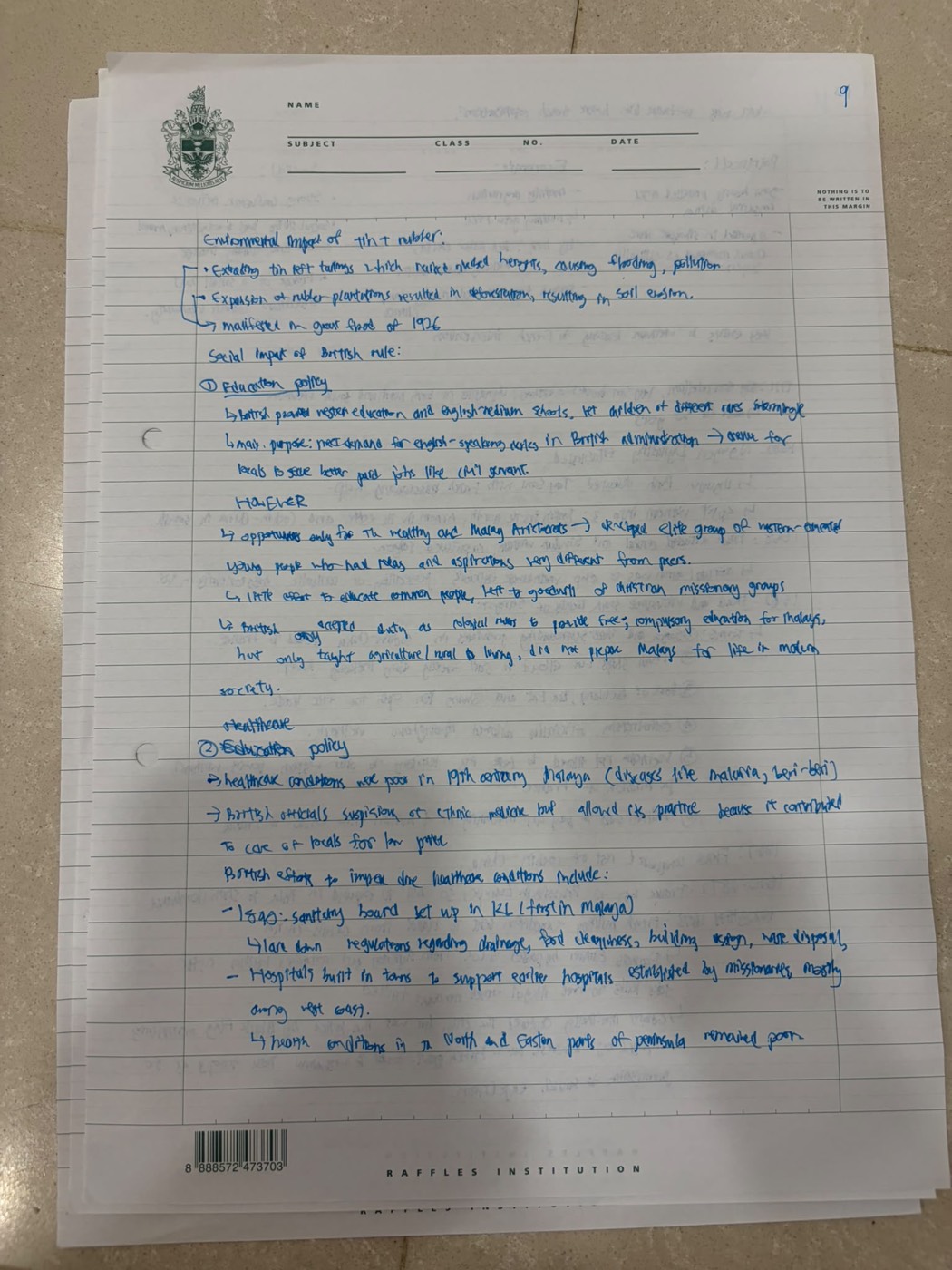
8 · Environmental and social impact of British rule
Environment
- Tin mining left tailings (waste) that raised riverbeds, causing flooding and pollution.
- Rubber plantations meant deforestation, which caused soil erosion.
- Both came together in the Great Flood of 1926.
Education
- Britain promoted Western, English-medium schools where children of different races mixed.
- Main purpose: supply English-speaking clerks for the British administration, which gave locals a route to better-paid jobs like the civil service.
- However: these chances went mostly to the wealthy and Malay aristocrats, creating a Western-educated elite whose ideas differed sharply from everyone else's.
- Little effort to educate ordinary people; that was left to Christian missionary groups.
- Free vernacular education for Malays taught only farming and rural skills, and did not prepare Malays for modern life.
Healthcare
- Health in 19th-century Malaya was poor: malaria, beri-beri.
- British officials distrusted traditional ethnic medicine but allowed it, because it cared for locals cheaply.
- 1890: Kuala Lumpur Sanitary Board, the first in Malaya, sets rules on drainage, food hygiene, building design and waste disposal.
- Hospitals built in towns, mostly on the west coast, adding to earlier missionary hospitals.
- The north and east of the peninsula stayed poor.
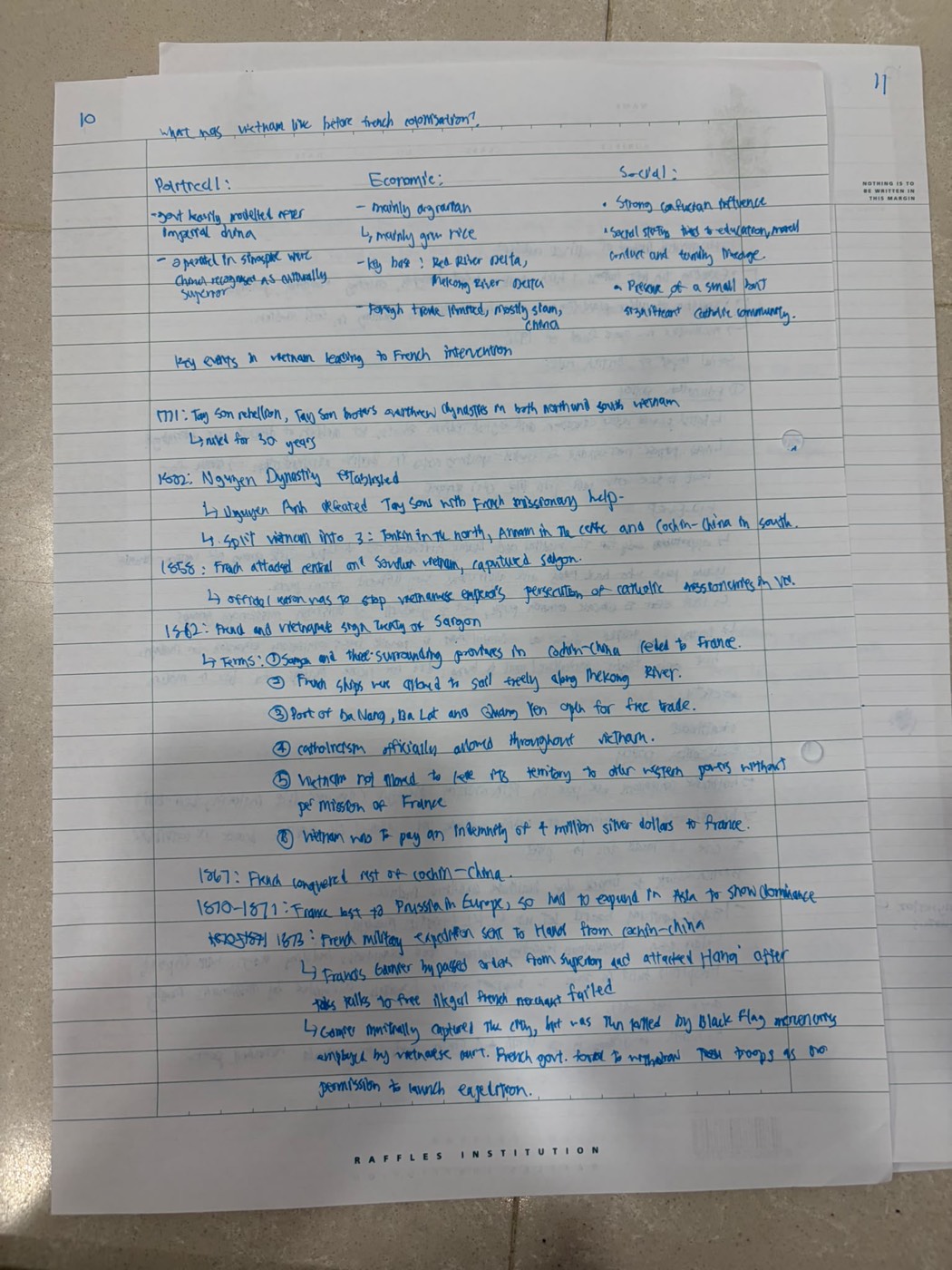
9 · Vietnam before the French
| Political | Economic | Social |
|---|---|---|
| Government closely modelled on imperial China, which Vietnam saw as culturally superior. | Mainly agrarian, mainly rice. Key areas: the Red River delta (north) and Mekong delta (south). Limited foreign trade, mostly with Siam and China. | Strong Confucian influence; status came from education, moral conduct and family line. A small but significant Catholic community. |
10 · How France took Vietnam, 1771 to 1887
- 1771Tay Son rebellion: the Tay Son brothers overthrow the ruling families in north and south and rule for about 30 years.
- 1802Nguyen dynasty founded. Nguyen Anh defeats the Tay Son with help from French missionaries, and the country is run as three parts: Tonkin (north), Annam (centre), Cochin-China (south).
- 1858France attacks central and southern Vietnam and later captures Saigon. Official reason: stop the emperor persecuting Catholic missionaries.
- 1862Treaty of Saigon: (1) Saigon and three surrounding provinces of Cochin-China go to France; (2) French ships may sail freely on the Mekong; (3) ports of Da Nang, Ba Lat and Quang Yen opened to trade; (4) Catholicism allowed throughout Vietnam; (5) Vietnam cannot give territory to another Western power without France's permission; (6) Vietnam pays an indemnity of 4 million silver dollars.
- 1867France conquers the rest of Cochin-China.
- 1870 to 1871France loses the Franco-Prussian War in Europe, and looks to Asia to restore its standing.
- 1873Francis Garnier leads an expedition from Cochin-China to Hanoi, ignores his superiors' orders and attacks Hanoi after talks to free a French merchant fail. He captures the city but is killed by Black Flag mercenaries hired by the Vietnamese court. France withdraws because the expedition was never approved.
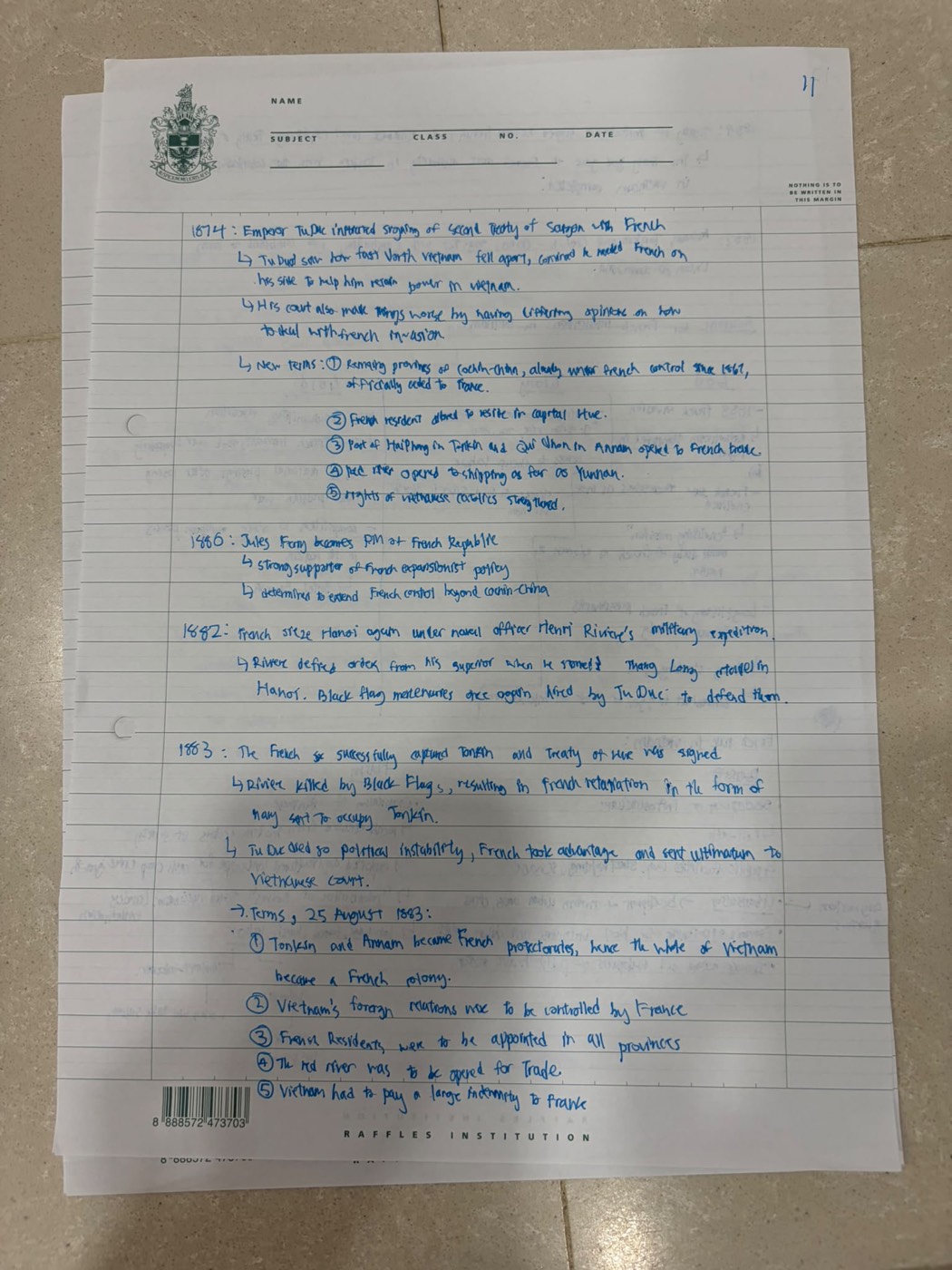
- 1874Second Treaty of Saigon. Emperor Tu Duc, seeing the north falling apart, decides he needs France on his side; his court is split on how to deal with France. Terms: (1) the rest of Cochin-China, French-held since 1867, formally ceded; (2) a French Resident may live in the capital, Hue; (3) Haiphong (Tonkin) and Qui Nhon (Annam) opened to French trade; (4) the Red River opened to shipping as far as Yunnan; (5) rights of Vietnamese Catholics strengthened.
- 1880Jules Ferry becomes Prime Minister of France: a strong expansionist, determined to go beyond Cochin-China.
- 1882Naval officer Henri Rivière seizes Hanoi, again against orders. Tu Duc hires the Black Flags again.
- 1883Rivière is killed by the Black Flags; France sends a navy to occupy Tonkin. Tu Duc dies and the court is in turmoil; France sends an ultimatum. Treaty of Hue (25 Aug 1883): (1) Tonkin and Annam become French protectorates, so all of Vietnam is under France; (2) France controls Vietnam's foreign relations; (3) French Residents in every province; (4) the Red River opened to trade; (5) a large indemnity to France.
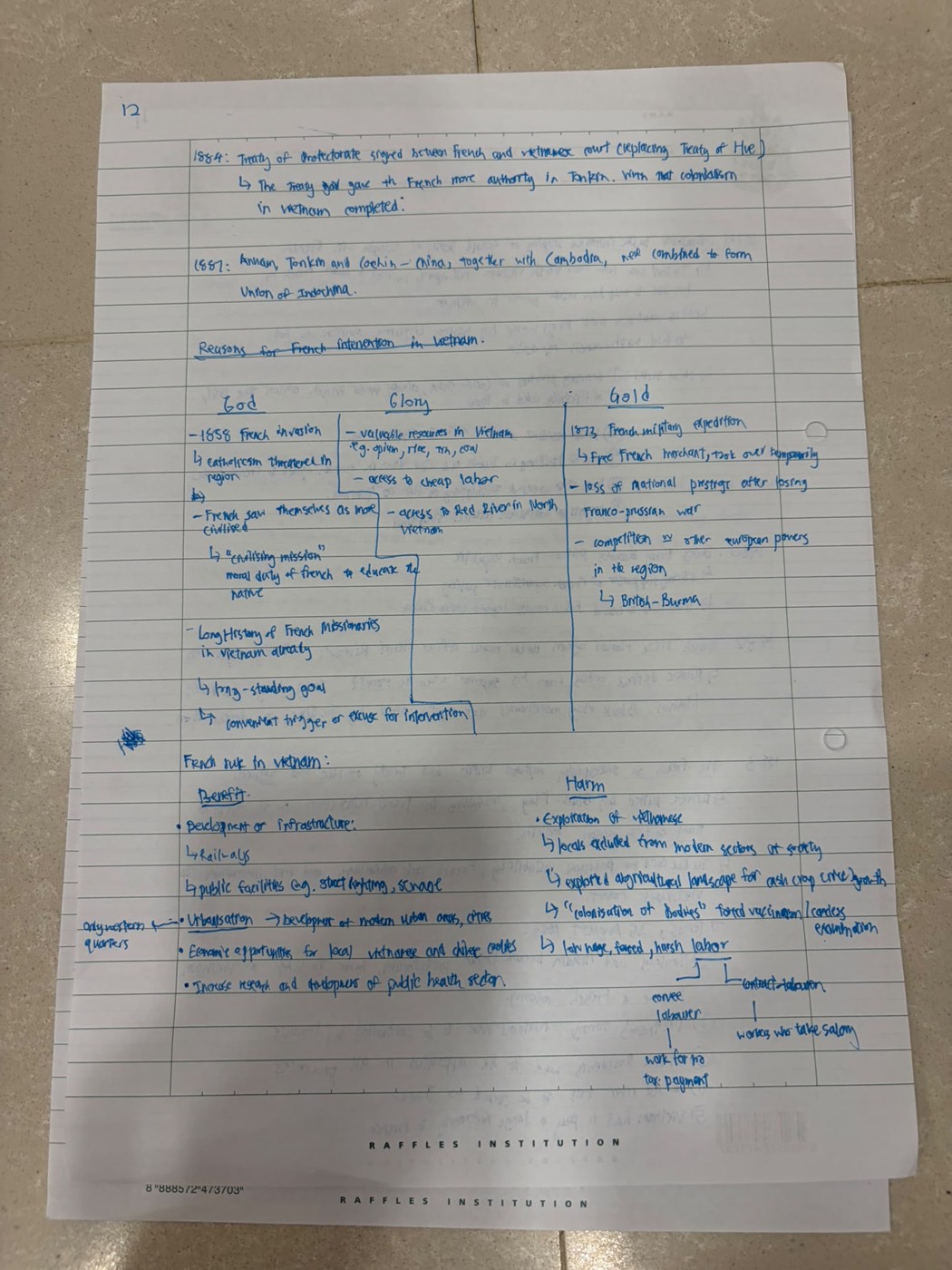
- 1884Treaty of Protectorate replaces the Treaty of Hue and gives France even more authority in Tonkin. Colonisation of Vietnam is complete.
- 1887Annam, Tonkin and Cochin-China plus Cambodia combined into the Union of Indochina.
11 · Why France did it: God, Glory, Gold
| God (religion) | Glory (prestige) | Gold (wealth) |
|---|---|---|
|
|
|
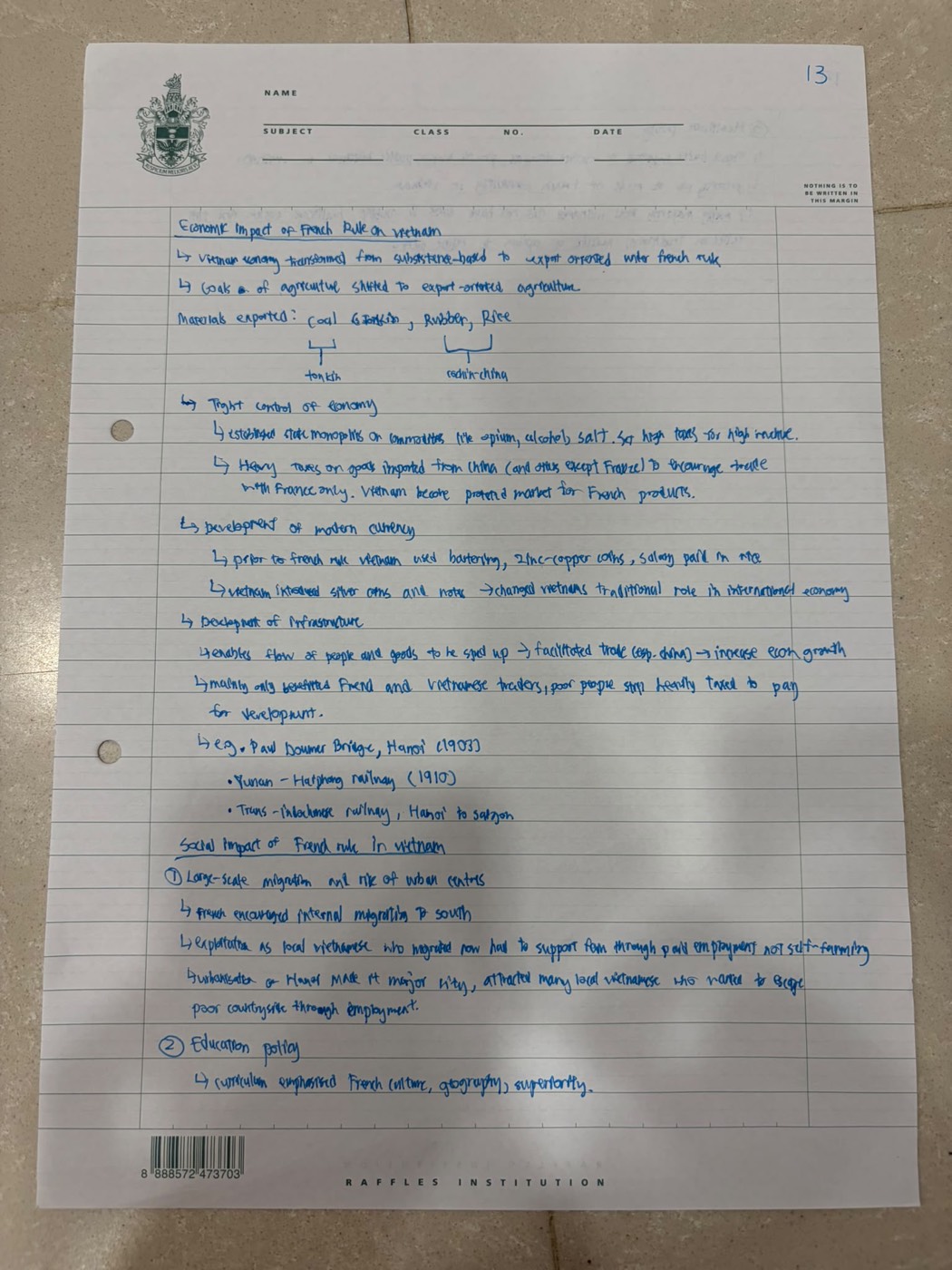
12 · Impact of French rule on Vietnam
Economic
- Economy shifted from subsistence to export; farming now aimed at export crops.
- Exports: coal from Tonkin; rubber and rice from Cochin-China.
- Tight control: state monopolies on opium, alcohol and salt, sold with high taxes for revenue. Heavy taxes on goods from China and other non-French sources, so Vietnam became a protected market for French products.
- Modern currency: before, Vietnam used barter, zinc and copper coins, and salaries paid in rice. Silver coins and notes changed Vietnam's role in the world economy.
- Infrastructure: sped up the movement of people and goods and boosted trade (especially with China). But it mainly benefited French and Vietnamese traders, while the poor were heavily taxed to pay for it. Examples: Paul Doumer Bridge, Hanoi (1903); Yunnan-Haiphong railway (1910); Trans-Indochinese railway, Hanoi to Saigon.
Social
- Migration and cities: France encouraged internal migration to the south. Migrants now had to live on paid work, not their own farms, which left them open to exploitation. Hanoi grew into a major city, drawing people escaping rural poverty.
- Education: the curriculum stressed French culture, French geography and French superiority.
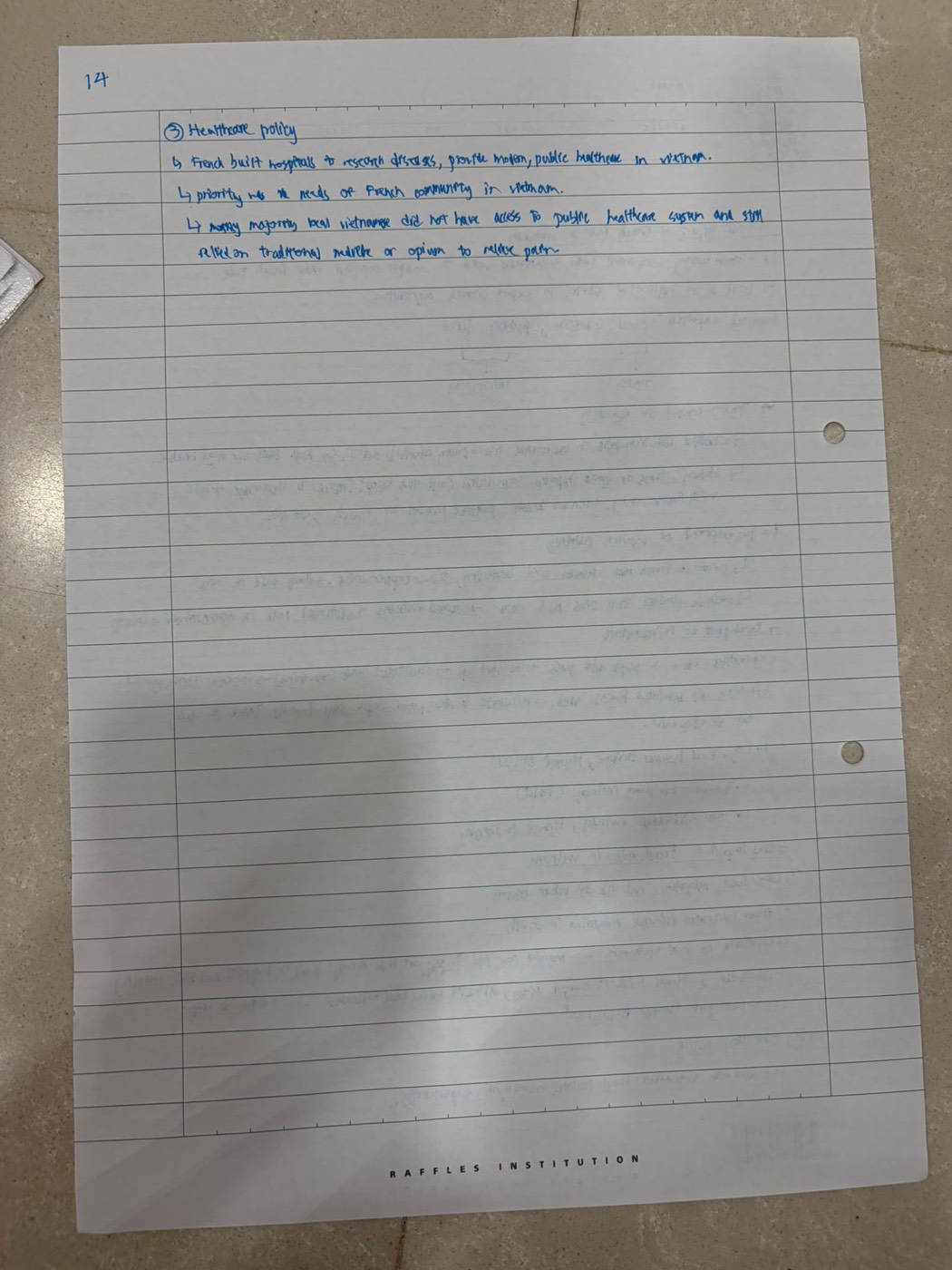
- Healthcare: France built hospitals for disease research and modern public health, but the priority was the French community. Most Vietnamese had no access and still relied on traditional medicine, or opium for pain.
Benefit or harm? (Samuel's summary)
Benefits
- Infrastructure: railways, street lighting, signage
- Urbanisation: modern urban areas (but only the Western quarters)
- Economic chances for local Vietnamese and Chinese traders
- More research and development in public health
Harm
- Locals shut out of the modern parts of society
- Farmland turned over to cash crops (rice) for export
- "Colonisation of bodies": forced vaccination, careless medical examinations
- Low-wage, forced, harsh labour: corvée labour (unpaid work in place of tax) and contract labour (paid, but on harsh terms)
13 · Malaya vs Vietnam side by side
| Malaya (Britain) | Vietnam (France) | |
|---|---|---|
| Door-opener | Civil war in Perak (Larut Wars + succession) | Persecution of Catholic missionaries |
| Main motive | Tin and trade security | God, Glory and Gold together; prestige after 1871 |
| Key treaty | Pangkor 1874 | Saigon 1862, Saigon 1874, Hue 1883, Protectorate 1884 |
| Style | Mostly indirect, through Sultans and Residents; little fighting after 1876 | Repeated military expeditions; direct rule in Cochin-China, protectorates elsewhere |
| Local ruler | Sultans kept religion and custom | Emperor lost foreign policy, French Residents in every province |
| Economy | Tin and rubber exports, European capital, immigrant labour | Coal, rice and rubber exports, monopolies, protected market for France |
| Who lost out | Malays kept to rice farming | Rural poor taxed to pay for development; forced labour |
Practice questions
Try each one in your head or on paper first, then open it.
1 · Name the three types of British control in Malaya and the British official in each.
Straits Settlements: direct rule under a Governor. Federated Malay States: indirect rule through a Resident in each state, under a Resident-General. Unfederated Malay States: looser rule through an Adviser in each state.
2 · Why did British intervention begin in 1874 and not earlier?
Before 1874 the Liberal government under Gladstone opposed empire-building. In 1874 Disraeli's Conservatives came to power and favoured expansion. At the same moment Perak was in civil war (4th Larut War plus the succession dispute), which disrupted trade in the Straits Settlements and gave Britain a "peacekeeping" reason to step in. Tin demand and the Dutch move into Aceh (1873) added urgency.
3 · What was the Residential clause of the Pangkor Treaty, and why did it give Britain real power?
The Sultan had to accept a British Resident whose advice must be asked and acted upon on all questions except Malay religion and custom. Since "advice" had to be followed, and the Resident also controlled revenue, real executive and law-making power passed to Britain while the Sultan kept only religion and custom.
4 · "Birch failed because of his personality." How far do you agree?
Partly agree. His arrogance, poor Malay and contempt for local customs made the chiefs hostile. But his policies did more damage: he stopped the chiefs' tax collection without compensation (taking their income), replaced the Sultan as chief judge, and helped slaves escape (attacking custom and status). He also had no army or clear guidelines. Hugh Low did the same jobs with compensation, gradual change and a State Council, and succeeded, which shows the methods mattered as much as the man.
5 · Give two ways the Perak State Council helped British rule.
Including Ghee Hin and Hai San leaders meant mining disputes were settled by discussion instead of war. Including the Sultan (as president) and Malay chiefs gave them a voice in policy and reduced resistance to British control.
6 · How did British land policy hold back the Malay community? Use two examples.
The 1917 Rice Lands Enactment limited Malay land to rice, the least valuable crop, keeping Malays out of rubber and tin and widening the income gap with Europeans. The Stevenson Restriction Scheme (1922 to 1928) gave smallholdings, mostly Malay, only about a third of the rubber quota even though they could produce more.
7 · List three terms of the 1862 Treaty of Saigon.
Any three of: Saigon and three provinces of Cochin-China ceded to France; free French navigation on the Mekong; Da Nang, Ba Lat and Quang Yen opened to trade; Catholicism allowed; no territory to other Western powers without French permission; 4 million silver dollars indemnity.
8 · Which treaty made the whole of Vietnam French, and what made it possible in 1883?
The Treaty of Hue (25 August 1883), confirmed by the Treaty of Protectorate in 1884. It came after Rivière's death gave France a reason to send the navy into Tonkin, and Emperor Tu Duc's death left the court weak and divided, so it could not resist France's ultimatum.
9 · Sort these into God, Glory or Gold: Franco-Prussian War; coal; civilising mission; Red River; British in Burma; missionaries.
God: civilising mission, missionaries. Glory: Franco-Prussian War, British in Burma. Gold: coal, Red River.
10 · "French infrastructure benefited the Vietnamese people." How far do you agree?
To a limited extent. Railways like Yunnan-Haiphong and the Trans-Indochinese line sped up trade and growth, and cities like Hanoi offered jobs. But the main gains went to French and Vietnamese traders, the poor were heavily taxed to pay for it, much was built with corvée labour, and modern facilities were mostly in the Western quarters of cities.
Worth checking with the teacher
- Rice Lands Enactment: the standard date is 1917; the handwriting could read 1933. Use 1917 unless your teacher says otherwise.
- Kuala Lumpur Sanitary Board: usually dated 1890; check the year your class was given.
- Johor: the notes say Johor did not join the UMS; most textbooks count Johor as a UMS once it accepted a British General Adviser in 1914. Worth asking how your teacher wants it phrased.
- Hugh Low's appointment: the notes say February 1877; many sources give April 1877. Either way, "1877" is safe.
- Numbers taken straight from class (Suez travel time, tin revenue, Stevenson quota percentages) are kept as given.
Samuel's original pages
Show the 14 handwritten pages (tap a page to open it full size)
Lesson of Sunday, 4 October 2026 (the day these notes were shared) · Raffles Institution
Built from Samuel's 14 pages of handwritten notes; names, dates and treaty terms checked, with a few corrections listed under "Worth checking with the teacher".